
Crossword clue solving
How to use a crossword clue solver without losing the fun
A useful solver turns the information already in the grid into a focused next step and lets you decide how much help to reveal.
Start with the clue exactly as it appears
Enter the complete clue before trimming words that look unimportant. A short word such as “about,” “back,” or “initially” can be essential in a cryptic clue, while punctuation and tense can help clarify what kind of answer is needed. If the clue includes its answer length, include that too.
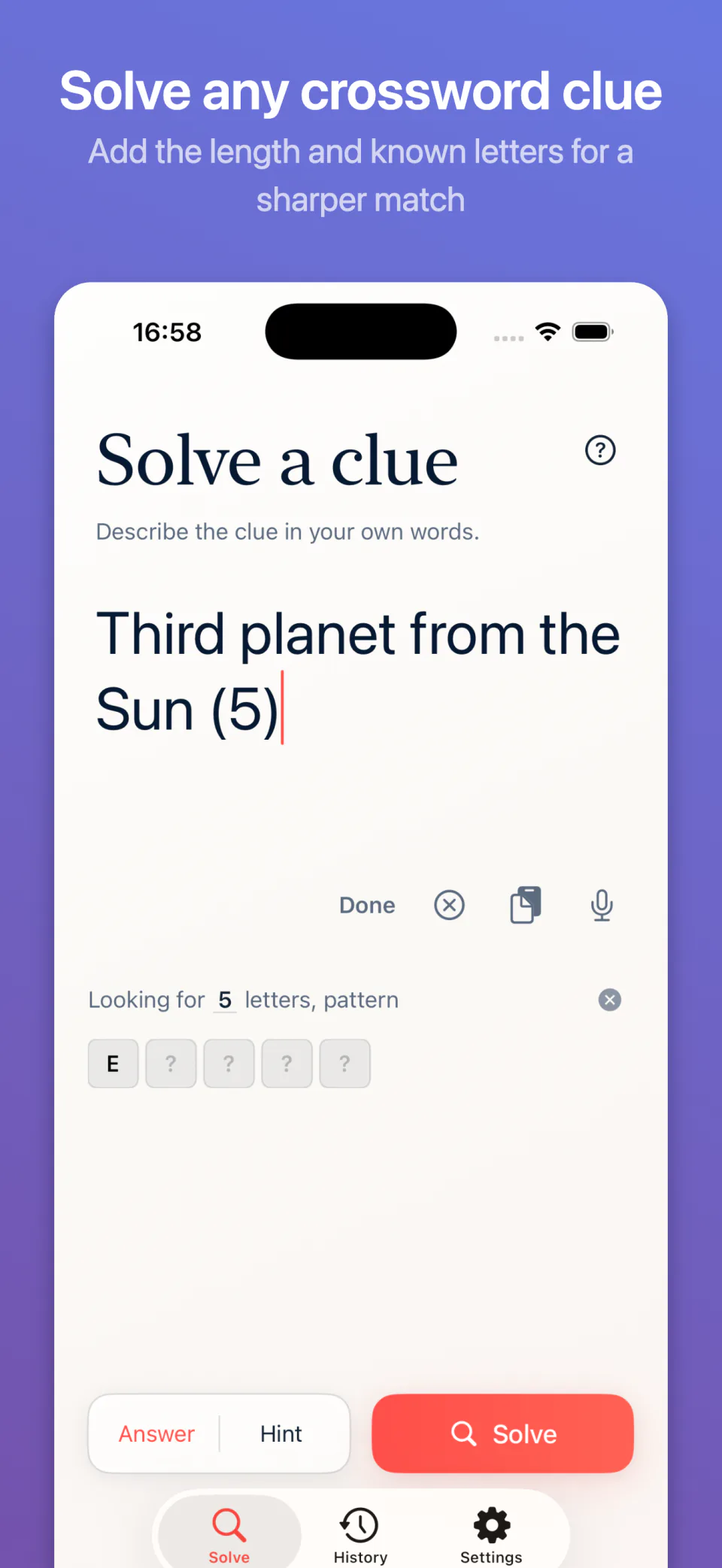
When speaking a clue, say it naturally and finish with the letter count. For example: “Third planet from the Sun, five letters.” A complete clue gives the solver more context than a loose topic such as “planets.”
Add the answer length early
Enumeration, the number of letters or words in the answer, is one of the strongest filters available. A clue that could suggest several synonyms becomes much more precise when the required length is known. Multiword answers are commonly written as (5, 4), while a hyphenated answer might appear as (4-3).
Clue: Third planet from the Sun (5)
Why the length matters: “Earth” fits both the definition and the five-letter requirement.
Use crossing letters, but only when you trust them
Known letters can turn a broad search into a sharp match. Add letters confirmed by crossing answers and leave uncertain positions blank. One incorrect crossing can exclude the right answer, so remove or unlock a letter if every result feels strained.
Patterns work best as supporting evidence, not a replacement for the clue. The clue establishes meaning; the pattern checks the shape. See the letter-pattern guide for practical examples.
Choose between an answer and a hint
Use answer mode when you need to keep the grid moving or want to confirm a likely solution. Use hint mode when you still want the satisfaction of solving the clue yourself. A useful hint sequence should progress from broad to specific: definition, wordplay, edge letters, then a partial pattern.
If you are working on a cryptic clue, resist revealing letters immediately. Identifying the definition and construction first often teaches you more than seeing the finished word. Our cryptic hints guide explains that process.
Check why the answer fits
A plausible word is not automatically the correct answer. Confirm that it matches the clue’s tense, number, part of speech, enumeration, and crossing letters. For cryptics, every part of the clue should contribute to either the definition or the wordplay, aside from small linking words.
When a suggestion does not fit, refine the search instead of repeatedly submitting the same information. Add a reliable letter, remove a doubtful one, request more answers, or ask for a different explanation.
Three complete solving workflows
1. A direct clue with a unique short answer
Input: Man’s best friend (3)
Crossy’s top match: DOG · Very likely
Check: DOG is three letters and directly answers the conventional description.
This is the simple case: definition, length, and common usage agree. The explanation is still useful because it makes the basis of the answer explicit instead of presenting an unexplained word.
2. A clue that stays ambiguous after one crossing
Input: The beginning (5)
Known pattern: ????T
Plausible candidates: START, ONSET, DEBUT
Every candidate has five letters, ends in T, and can relate to a beginning. A responsible solver should rank possibilities without pretending the clue is settled. Add another confirmed crossing or use the puzzle’s theme before committing.
3. A cryptic clue where a hint is more useful than a reveal
Input: Mixed tone gives musical sound (4)
Hint 1: The definition is “a musical sound.”
Hint 2: Mix the letters of “tone.”
Hint 3: The answer begins with N.
Answer when requested: NOTE
Here the explanation is proof: “mixed” indicates an anagram, TONE supplies exactly four letters, and NOTE matches the definition. Stopping after the second hint preserves most of the solve.
Common mistakes to avoid
- Searching only a topic: enter the whole clue, not just its subject.
- Forcing an uncertain letter: blank spaces are safer than incorrect constraints.
- Ignoring grammar: plural clues generally need plural answers, and verb tense matters.
- Accepting a synonym without checking: use crossings and the explanation to verify the match.
- Revealing too much too quickly: switch to guided hints when you want to keep solving.
Crossword clue solver questions
What information improves a crossword clue solver result?
Enter the full clue, the exact answer length, and only the crossing letters you trust. Together, those constraints narrow the suggestions without excluding the correct answer.
When should I use crossword hint mode instead of answer mode?
Use hint mode when you want to keep solving. Start with the definition or wordplay, then reveal an edge letter or partial pattern only if you still need help.