Cryptic crossword hints
How to get cryptic crossword hints without the answer
A cryptic clue usually tells you the answer twice: once through a definition and once through a construction. Learning to find those two parts makes the clue feel fair instead of mysterious.

The basic anatomy of a cryptic clue
Most cryptic clues contain a direct definition, a piece of wordplay, and sometimes a short linking phrase. The definition is often at the beginning or end. The wordplay supplies a second route to the same answer through operations such as rearranging, joining, hiding, reversing, or removing letters.
The answer must satisfy both routes as well as the enumeration. If a word fits the definition but the wordplay cannot account for its letters, it is probably not the intended solution.
Example clue: Mixed tone gives musical sound (4)
Definition: musical sound
Wordplay: “Mixed” signals an anagram of TONE, producing NOTE.
Learn the most common constructions
Anagrams
An anagram clue provides letters and an indicator suggesting change or disorder. Words such as “mixed,” “broken,” “wild,” or “confused” may act as indicators, but their role depends on the full clue.
Hidden answers
The answer appears consecutively inside the clue. Indicators might suggest containment or discovery: “in,” “part of,” “some of,” or “revealed by.” Check the boundaries between words as well as the middle of a single word.
Charades and containers
A charade builds the answer by placing smaller pieces side by side. A container puts one set of letters inside another. Phrases such as “around,” “holding,” or “embracing” can indicate containment, while a sequence of short synonyms may signal a charade.
Reversals and deletions
Reversal indicators depend on clue direction: “back” or “returned” commonly work in across clues, while “rising” may work in a down clue. Deletions remove a first, last, or internal letter using language such as “endless,” “headless,” or “without.”
Double definitions
These clues offer two different definitions of the same answer, often with very little connecting language. They can look deceptively simple because there may be no obvious indicator.
Worked examples of the main constructions
The indicator is contextual: a word such as “back” or “mixed” only performs an operation when the surrounding grammar supports it. Use these examples as patterns, not as a promise that an indicator always has one meaning.
| Construction | Original clue | Answer and parse |
|---|---|---|
| Anagram | Mixed tone gives musical sound (4) | NOTE: TONE mixed; definition “musical sound” |
| Hidden answer | Road concealed by plan entrance (4) | LANE: pLAN Entrance; definition “road” |
| Container | Vehicle from cat holding river (4) | CART: CAT holds R; definition “vehicle” |
| Charade | Rock from saint with one (5) | STONE: ST + ONE; definition “rock” |
| Reversal | Wicked live returned (4) | EVIL: LIVE returned; definition “wicked” |
| Deletion | Level planet without its end (5) | PLANE: PLANET without final T; definition “level” |
| Homophone | Spots seas, reportedly (4) | SEES: sounds like “seas”; definition “spots” |
| Double definition | Throw on a playing field (5) | PITCH: both “throw” and “playing field” |
How to reject a tempting but incomplete parse
Write down the definition, indicator, source letters, and operation separately. Then spell the answer from those components. If a letter appears without a source, source letters are left unused, or the indicator does not grammatically control the operation, the parse is incomplete even when the final word fits the grid.
Crossing letters can confirm a construction, but they cannot repair invalid wordplay. When a strong crossing conflicts with an otherwise exact parse, recheck both entries and the puzzle’s theme.
Use hints in a useful order
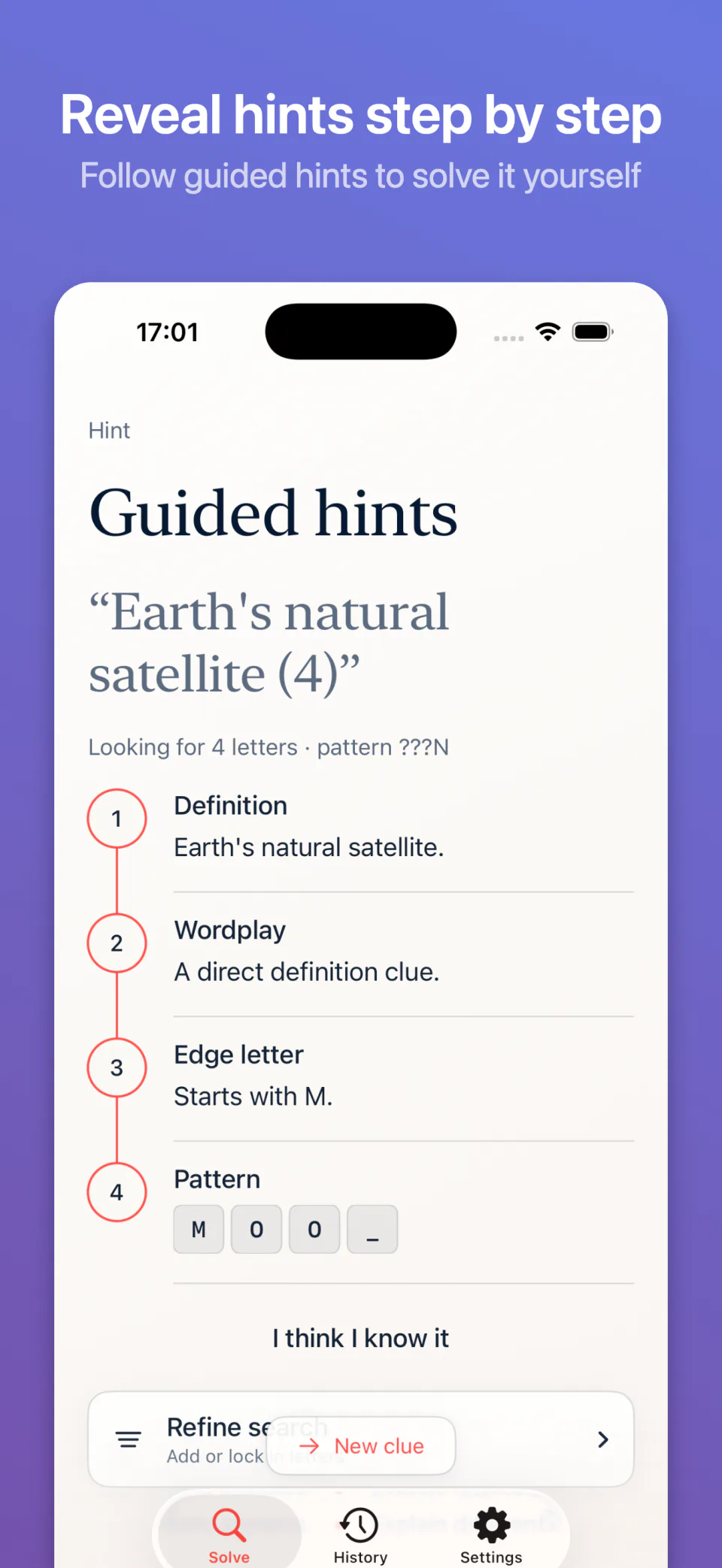
When you are stuck, reveal structural help before answer letters. A good progression is:
- Identify which end of the clue is likely the definition.
- Name the probable construction: anagram, hidden word, container, or another type.
- Identify the source letters or smaller components.
- Reveal an edge letter or partial pattern only if the construction is still unclear.
- Show the answer after you have had a chance to assemble it.
This order teaches the mechanism behind the clue. It also makes the next clue of the same type easier.
Let crossing letters confirm, not dictate
Crossing letters are especially helpful when a clue has an unfamiliar abbreviation or several plausible synonyms. Enter only letters you trust. If the wordplay points strongly to an answer that conflicts with one crossing, revisit the crossing rather than forcing the cryptic construction to fit.
For a systematic approach, read our guide to crossword letter patterns. If you want a broader solving workflow, start with how to use a clue solver effectively.
Cryptic crossword hint questions
What should the first cryptic crossword hint reveal?
Start by identifying the likely definition and whether it sits at the beginning or end of the clue. That preserves the wordplay challenge while giving you a firm direction.
How can I tell whether a cryptic answer is fully parsed?
The definition must match, the enumeration must fit, and the wordplay must account for every answer letter. An unexplained letter or unused source usually means the parse is incomplete.