
Crossword letter patterns
How to solve a crossword with known letters
A partial pattern can eliminate dozens of plausible synonyms. Combine reliable letters with the clue’s meaning while leaving room for uncertainty.

Begin with enumeration
Before entering any letters, record the answer length shown beside the clue. Enumeration tells you the total size and whether the answer contains multiple words or a hyphen. This is useful even when no crossing letters are available.
Single word: (5)
Two words: (5, 4)
Hyphenated: (4-3)
Represent unknown letters consistently
Use a question mark or blank for every unknown position. Keep confirmed letters in their exact places. A three-letter pattern with only the middle letter known can be written as:
This matches words such as CAT, MAP, or RAN, but the clue determines which meaning is relevant.
A four-letter answer beginning with B and ending with K becomes:
The pattern narrows the shape; the clue separates BOOK, BACK, BEAK, and other possibilities.
Add only reliable crossings
A letter is useful when its crossing answer is well supported by both clue and grid. If a crossing was itself a guess, treat that letter as provisional. One wrong character can remove the correct solution entirely and make weak alternatives look stronger than they are.
When no result fits naturally, loosen the least certain constraint first. Do not rewrite the clue to justify a pattern that may be wrong.
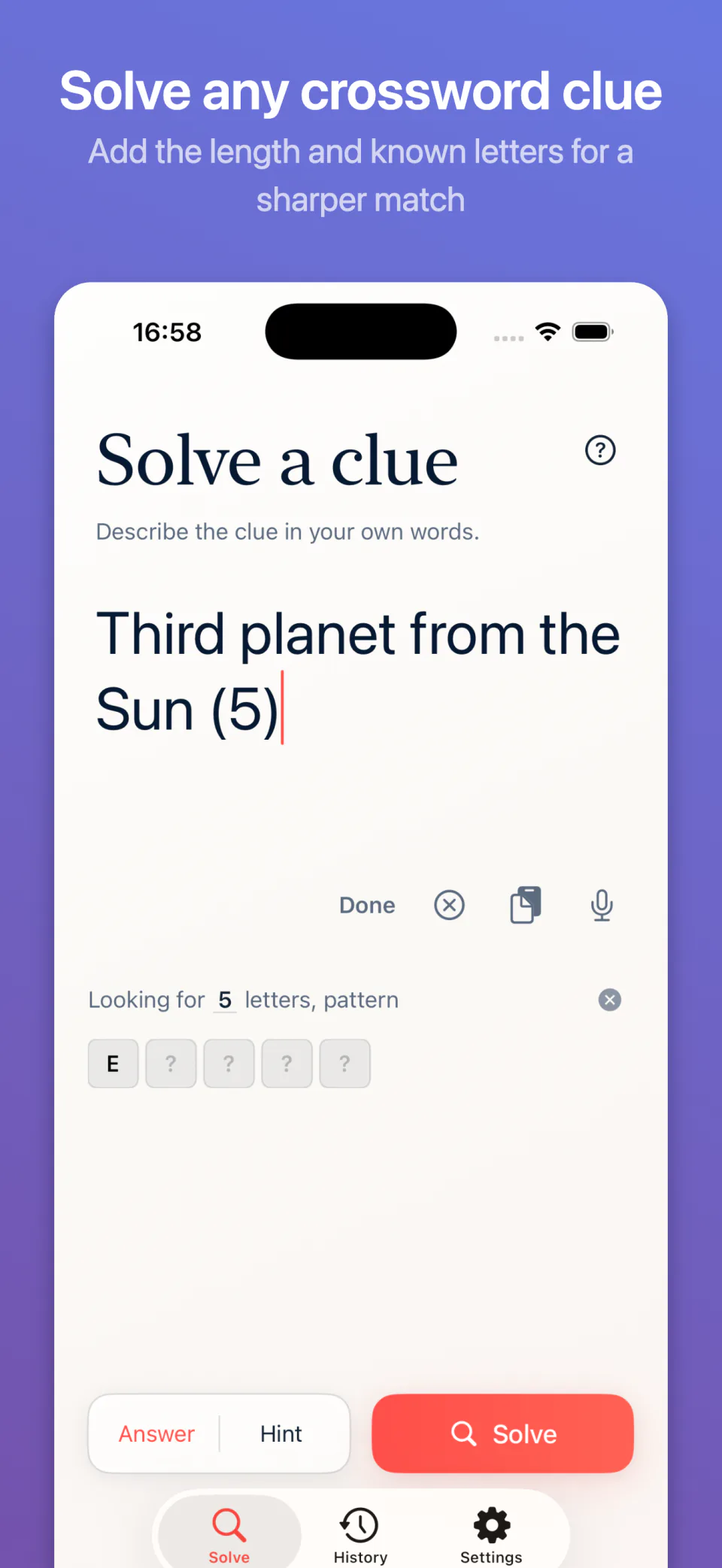
Combine pattern and meaning
Pattern matching alone cannot reliably distinguish words with the same shape. A clue solver should consider the definition, grammar, context, enumeration, and known letters together. For example, a plural clue usually expects a plural answer, while a clue written in the past tense often points to a past-tense verb.
This is why entering the whole clue matters. A pattern such as ?A? is broad; “Feline pet (3)” supplies the meaning that leads to CAT.
Refine as the grid changes
- Enter the full clue and its answer length.
- Add letters confirmed by solved crossings.
- Review the strongest answer and its explanation.
- Lock in a new letter when another crossing confirms it.
- Remove a constraint when all suggestions conflict with the clue.
A good refinement flow keeps the same clue and updates only the evidence. You should not need to start the search again each time the grid reveals another letter.
One pattern can still leave several correct candidates
Clue: The beginning (5)
Pattern: ????T
Possible answers: START, ONSET, DEBUT
All three words fit the definition broadly, contain five letters, and end in T. The pattern has improved the search without resolving it. Another crossing, a theme, or a more specific interpretation must do the remaining work.
How to spot a wrong crossing
A doubtful crossing often announces itself when every candidate becomes obscure or grammatically strained. Use this order:
- Check that the clue and answer length were copied correctly.
- Identify which known letter came from the least certain crossing answer.
- Clear only that position and compare the new candidates.
- Restore the letter if the results do not improve; test the next weakest crossing.
This preserves reliable information while avoiding a complete restart. The broader answer-mismatch checklist covers grammar, variants, themes, and cryptic parsing too.
Patterns in cryptic crosswords
Known letters are useful for cryptics, but the wordplay should still explain every part of the answer. Let the pattern suggest where to look, then confirm the construction. If the clue appears to contain an anagram, for example, the source letters must still account for the result.
Read the cryptic hints guide to recognize common constructions, or use the broader clue-solving workflow when you are unsure where to begin.
Known-letter questions
Should I enter a crossing letter if I am not sure it is correct?
Leave an uncertain position blank. A wrong letter can exclude the correct answer and make weaker candidates appear stronger.
What should I do when a crossword letter pattern returns no good answer?
Check the enumeration and clear the least reliable crossing first. Compare the new suggestions before removing another letter.