Crossword troubleshooting
Why does my crossword answer not fit?
When a candidate looks right but conflicts with the grid, do not bend the clue around it. Check the evidence in an order that makes the weakest assumption easy to find.

1. Confirm the clue and enumeration
Start with transcription errors. A missing “not,” an overlooked question mark, or a mistaken answer count can change the problem completely. Count letters without spaces or hyphens unless the puzzle states another convention. Keep multiword breaks such as (3, 5) and hyphenation such as (4-4), because they distinguish answers with the same total length.
2. Check grammar, not just meaning
A candidate can be a strong synonym and still have the wrong form. Compare tense, number, and part of speech:
| Clue asks for | Mismatch | What to seek |
|---|---|---|
| Began | START | A past-tense verb such as STARTED |
| Silent | SILENCE | An adjective, not a noun |
| Birds | TERN | A plural answer such as TERNS |
Crossword clues are compressed, but their grammar is usually deliberate. Treat it as a crossing letter for the whole word.
3. Reassess the least certain crossing
A crossing is only useful when its own answer is supported. If every natural candidate conflicts with the same position, unlock that letter first. Do not discard a clean definition to preserve a crossing that began as a guess.
Clue: The beginning (5)
Pattern: ????T
Still possible: START, ONSET, and DEBUT
Lesson: one final T narrows the field, but it does not make the clue unique. More crossings or theme context are still needed.
4. Look for a convention signal
“Briefly,” “for short,” “abbr.,” and similar wording may require a shortened answer. A question mark can signal a pun or unusually loose definition. Capitalization may indicate a name or title. If you overlooked the signal, your full-length synonym may be answering a different clue from the one the constructor wrote.
5. Consider spelling and word boundaries
British and American spellings, variant transliterations, nicknames, and omitted punctuation can change the grid form. A phrase may be entered without its space, while a hyphenated term may occupy ordinary squares. Do not silently switch spelling systems unless the publication, crossings, or other answers support it.
6. Check the puzzle’s theme
If several otherwise sound answers fail in a consistent way, the theme may remove letters, add a shared word, use rebus squares, or transform entries. Read the puzzle title and instructions again. A clue solver sees only the context you provide; it cannot know that a particular square represents three letters unless you say so.
7. For cryptics, demand a complete parse
A cryptic answer is not established by definition and crossings alone. Identify the definition, indicator, source letters, and operations. Every answer letter must be accounted for. If “Mixed tone gives musical sound (4)” suggests NOTE, the proof is exact: TONE supplies all four letters, “mixed” orders an anagram, and “musical sound” defines NOTE.
If a candidate fits the definition but needs an unexplained extra letter, it is not a complete solution. Read the cryptic hints guide for examples of valid constructions.
8. Treat rankings as proposals
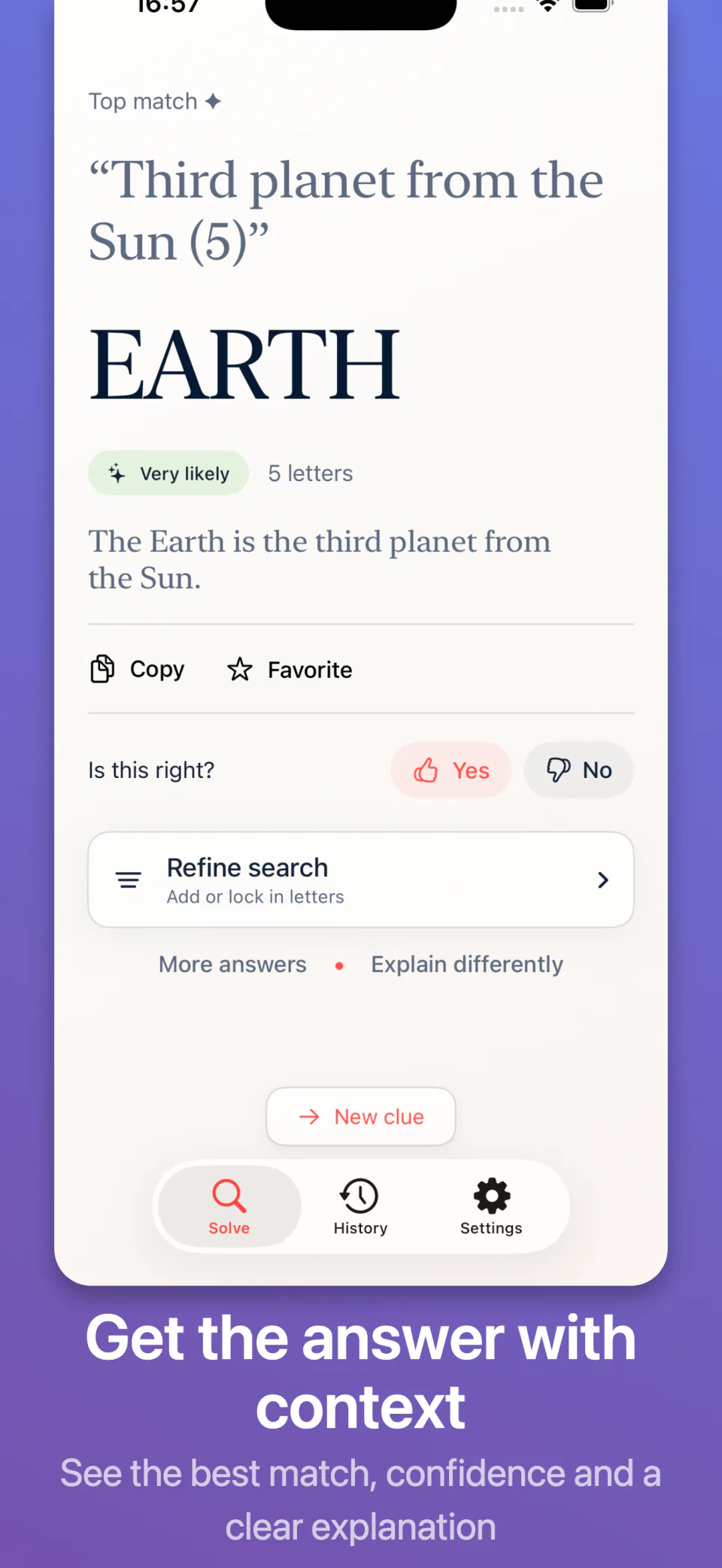
A solver’s top match is the strongest candidate it found, not a guarantee. A short clue may reasonably produce several ranked answers. Read the explanation, compare alternatives, and add only information that came from the grid. Asking for a different explanation can expose whether the match is genuinely supported or merely plausible.
A quick recovery sequence
- Re-enter the exact clue and count.
- Remove the least certain known letter.
- Check grammar and abbreviation signals.
- Inspect spelling, word breaks, and puzzle instructions.
- Request alternatives instead of repeating the same search.
- For cryptics, verify the construction letter by letter.
Useful rule: loosen uncertain evidence before adding new guesses. One blank is less damaging than one wrong locked letter.
Crossword answer mismatch questions
Which crossing letter should I remove first when an answer does not fit?
Clear the letter supplied by the least certain crossing answer. Keep stronger crossings in place and compare the new candidates before removing anything else.
Can a correct crossword answer still appear not to fit the grid?
Yes. A theme may remove or add letters, use a rebus square, or transform entries. Recheck the puzzle title and instructions when several strong answers fail in the same systematic way.