Crossword clue types
How to identify crossword clue types
A clue’s wording tells you what kind of relationship to look for. Identifying that relationship early is often more useful than trying a longer list of synonyms.

Start with grammar and punctuation
Before classifying a clue, check its tense, number, part of speech, capitalization, and punctuation. A plural noun clue normally expects a plural noun. An abbreviated clue usually expects an abbreviated answer. A question mark often warns that the surface reading is playful. None of these is an absolute rule, but each is evidence.
| Clue type | Typical signal | Original example | Answer |
|---|---|---|---|
| Direct definition | A plain synonym or description | Man’s best friend (3) | DOG |
| Fill in the blank | A visible gap in a familiar phrase | ___ and behold (2) | LO |
| Abbreviation | “Briefly,” “for short,” or an abbreviated clue | Doctor, briefly (2) | DR |
| Question-mark clue | A pun, unusual definition, or deliberately loose reading | Footwear for one who sneaks around? (7) | SNEAKER |
| Knowledge clue | A factual relationship rather than a synonym | Greek letter after pi (3) | RHO |
| Cryptic construction | A definition plus instructions that build the answer | Mixed tone gives musical sound (4) | NOTE |
Direct definitions and synonyms
A direct clue asks for a word or phrase with the same meaning as the clue. The challenge is that several answers may be equally plausible until enumeration and crossings separate them. “The beginning (5)” could suggest START, ONSET, or another five-letter word. The clue does not become more precise just because a solver ranks one first.
Check grammatical fit as carefully as meaning. “Began” asks for a past-tense verb; “beginning” may ask for a noun or adjective depending on the rest of the clue. When several candidates remain, crossings are evidence, not a nuisance to work around.
Fill-in-the-blank clues
These clues present part of a quotation, title, idiom, or fixed expression. Read the words on both sides of the gap before considering free synonyms. In “___ and behold (2),” the fixed phrase gives LO. A different two-letter interjection may fit the length but not the expression.
Capitalization can indicate a title or proper name, although constructors sometimes disguise it at the beginning of a clue. Crossing letters are especially useful when the missing portion is a person, place, song, or film.
Abbreviations and shortened forms
Constructors normally signal a shortened answer. Look for “briefly,” “for short,” “abbr.,” an abbreviated word in the clue, or a category whose members are conventionally shortened. “Doctor, briefly (2)” points to DR rather than MEDIC.
The signal does not always identify one unique abbreviation. “Street” may be ST, while “saint” may also be ST. Use the rest of the clue and the crossings to decide. See the abbreviation and convention reference for a structured checklist.
Question marks, puns, and playful definitions
A question mark often tells you that the clue is not using a word in its most ordinary sense. “Footwear for one who sneaks around? (7)” can lead to SNEAKER: both a type of shoe and, playfully, someone who sneaks. The answer still needs to match the enumeration and crossings; the question mark licenses wordplay, not arbitrary association.
Try reading nouns as people, verbs as objects, and familiar phrases literally. If the joke works only after a long explanation, keep looking for a cleaner reading.
Factual and category clues
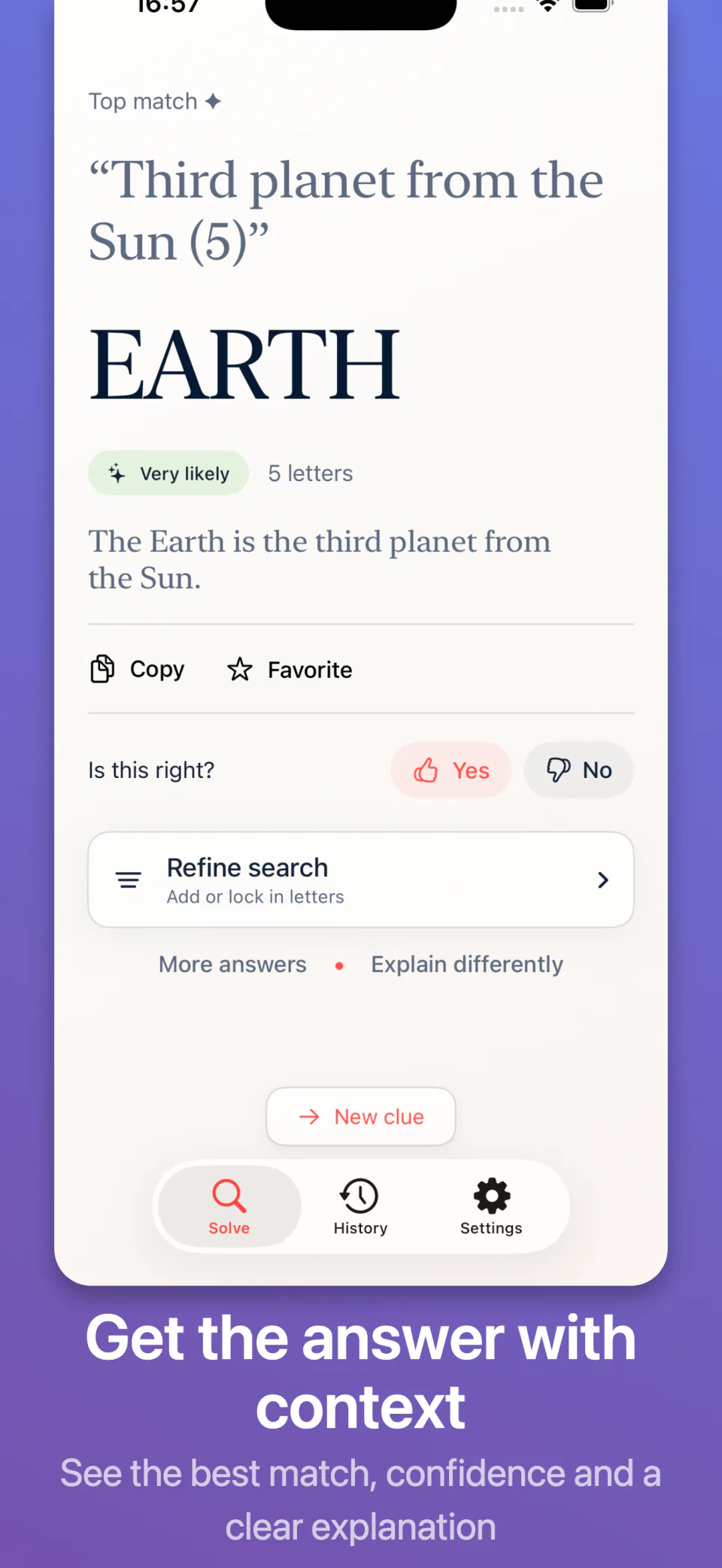
Some clues test knowledge rather than vocabulary: a capital city, chemical symbol, mythological figure, neighbouring planet, or item in a sequence. “Greek letter after pi (3)” gives RHO. These clues can be exact, but the answer may depend on spelling conventions or the publication’s preferred transliteration.
When a fact seems right but does not fit, confirm whether the grid expects a surname, first name, abbreviation, nickname, or older spelling.
Theme-dependent clues
A themed crossword may transform otherwise correct answers. Letters might be removed, added, substituted, rebussed into one square, or interpreted through a shared subject. The individual clue may not mention the transformation because the puzzle’s title, instructions, or other themed entries supply it.
Important limitation: a clue solver cannot infer a puzzle-specific rule that you have not provided. If several strong answers miss the grid in the same systematic way, inspect the theme before rejecting all of them.
Cryptic clues
A standard cryptic usually defines the answer once and constructs it a second time. In “Mixed tone gives musical sound (4),” “musical sound” is the definition, “mixed” is an anagram indicator, and TONE supplies exactly the letters of NOTE. Both routes must agree.
Common constructions include anagrams, hidden answers, charades, containers, reversals, deletions, homophones, and double definitions. Read the cryptic hints guide for a worked example of each.
A classification routine that works
- Record the exact clue and enumeration.
- Match tense, number, and part of speech.
- Look for explicit signals: a blank, abbreviation marker, question mark, or cryptic indicator.
- Ask whether external theme instructions affect the answer.
- Generate a small set of candidates, then test them against crossings.
- For cryptics, refuse any candidate whose letters are not fully explained.
Crossword clue type questions
Does a question mark always mean a crossword clue is a pun?
No. It usually warns that the clue uses a playful, loose, or unexpected reading, but the answer still has to fit the enumeration and crossings.
How do I know whether a crossword clue is cryptic?
A cryptic clue normally contains both a definition and wordplay that constructs the answer. Look for operation signals and check that the construction accounts for every letter.